
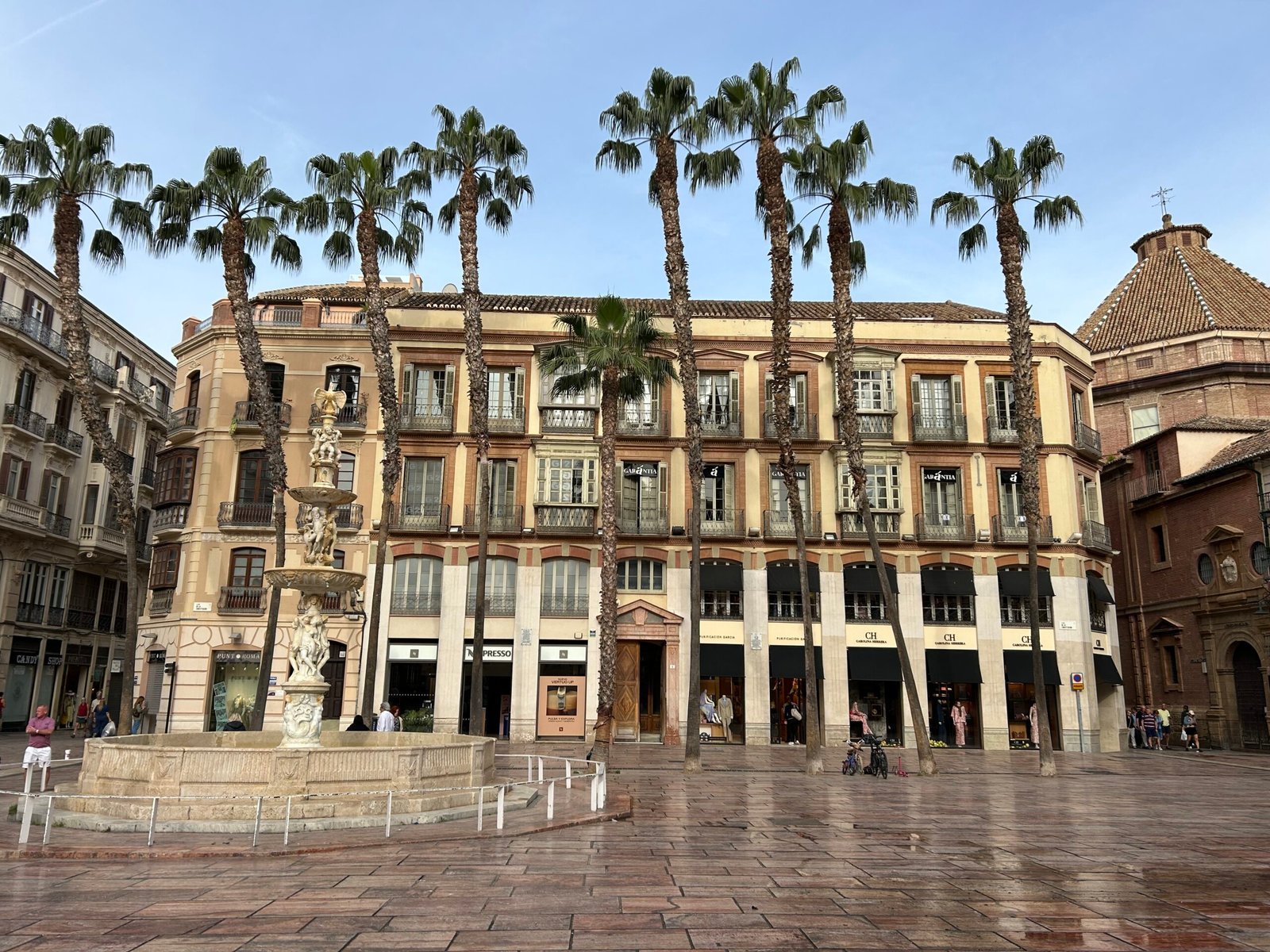
Málaga is one of Spain’s most underrated cities — and as local guides running daily walking tours here, we’d know. While most travellers rush through on their way to the beach, those who slow down discover a city packed with history, incredible food, world-class art, and a warmth that’s hard to find elsewhere. This guide is written by our local guides who lead tours through Málaga’s streets daily. No padding, no filler — just the 15 things actually worth your time, plus honest tips on how to make the most of each one.
Jump To Section
- Take a Free Walking Tour of Málaga
- The Alcazaba
- Picasso Museum
- Calle Larios
- La Manquita Cathedral
- Try Authentic Málaga Tapas
- Roman Theatre
- La Malagueta Beach
9. Centre Pompidou Málaga
10. Mercado de Atarazanas
11. Gibralfaro Castle & Best Viewpoint in Málaga
12. Soho Art District
13. Visit Picasso’s Birthplace
14. Carmen Thyssen Museum
15. Visit a Traditional Bodega
1. Take a Free Walking Tour of Málaga
The best introduction to the city

If you’re visiting Málaga for the first time — or even if you’ve been before — a free walking tour of Málaga is the best way to start your trip. In two hours you’ll cover the city’s essential landmarks, understand the layers of history that shaped it, and come away with dozens of local recommendations that no guidebook will give you.
Our Walkie Talkie Tours guides depart daily from Plaza de la Constitución and cover everything from Phoenician foundations to Picasso’s childhood, with detours into the stories Málaga usually keeps to itself. Small groups, licensed local guides, and no fixed price — you pay what you think it was worth at the end.
The free walking tour of Málaga’s historic centre is consistently one of the highest rated experiences in the city on GuruWalk and FreeTour — and it sets you up perfectly for everything else on this list.
2. Visit the Alcazaba — Málaga's Moorish Fortress
One of the best-preserved Arab fortresses in Spain
The Alcazaba of Málaga is one of the most impressive and underrated monuments in all of Spain. Built by the Moorish Hammudid dynasty in the 11th century, this hilltop fortress contains royal palaces, ornamental gardens, underground dungeons and some of the best panoramic views over the Mediterranean you’ll find anywhere in the city.
Most visitors walk past the entrance without going in. Inside, there are layers of history that take a good guide to unlock properly. The intricate Nasrid Palaces inside rival anything in Granada’s Alhambra, and almost nobody knows they exist.
Entry costs just €7 — one of the best value monuments in Andalusia. If you want to go deeper, our Free Tour Alcazaba Málaga & Roman Theatre covers the fortress in full with a licensed local guide.
3. Explore the Picasso Museum Málaga
The world's most famous artist was born here — and Málaga wears that proudly
The Picasso Museum Málaga is one of the most visited attractions in Andalusia — and rightly so. Housed in the stunning 16th-century Buenavista Palace in the heart of the historic centre, it contains over 200 works spanning Picasso’s entire career, donated largely by his daughter-in-law and grandson.
What makes this museum special isn’t just the art — it’s the building itself. As you move through the rooms, you can see original Phoenician and Roman archaeological remains discovered during the restoration. Art history and ancient history in the same building.
Local tip: Book tickets online in advance — the queue at the door in summer can be over an hour long. Early morning on a weekday is the quietest time to visit.
4. Calle Larios — Málaga's Most Famous Street
The most elegant pedestrian street in southern Spain — and the heart of the city
Calle Larios is Málaga’s most iconic street — a grand 19th-century boulevard lined with neoclassical facades, luxury shops and the kind of atmosphere that makes you want to slow down and stay a while. Named after the Larios family — the industrialists who shaped modern Málaga and whose name is on everything from the street to Spain’s most famous gin — it’s a living piece of the city’s history.
Most people walk it without knowing the story behind it. On our free walking tour of Málaga’s historic centre, your guide brings Calle Larios to life in a way no guidebook can — including the controversial story of how the Larios family built their empire.
Local tip: Come back in the evening when the street fills with locals on their paseo — it’s a completely different atmosphere and one of the most authentically Spanish things you can experience in Málaga.
5. Visit La Manquita — Málaga Cathedral
The one-armed lady of Málaga — and one of Andalusia's finest Renaissance buildings
Málaga Cathedral — known locally as La Manquita, meaning “the one-armed lady” — is one of the most distinctive landmarks in the city. Construction began in 1528 and was never fully completed — one of its towers was left unfinished, giving it the lopsided silhouette that Málaga’s residents have affectionately nicknamed ever since.
Inside, the cathedral is breathtaking — a vast Renaissance interior with an extraordinary cedar wood choir stall considered one of the finest in Spain. The rooftop tour is also highly recommended, offering a unique perspective over the city’s historic centre.
Local tip: The story of why the second tower was never built is one of the best in Málaga — ask your guide on the free walking tour for the full version.
6. Try Authentic Málaga Tapas
Skip the tourist restaurants — here's how to eat like a local in Málaga
Málaga has one of the best tapas scenes in all of Spain — and most tourists barely scratch the surface of it. The city has its own distinct food culture, shaped by its Moorish history, its fishing heritage and its position at the meeting point of the Mediterranean and the Atlantic.
The dishes you need to try: espetos (sardines grilled over an open fire on the beach), boquerones en vinagre (fresh anchovies in vinegar), berenjenas con miel (fried aubergines with sugarcane honey) and a glass of sweet Málaga wine at a traditional bodega. These aren’t things you’ll find in the tourist restaurants around the Cathedral — you need to know where to go.
Our Málaga Tapas Tour takes you to the hidden local bars and restaurants that most visitors never find — with a licensed local guide who knows the food scene inside out.
7. Discover the Roman Theatre of Málaga
A 2,000-year-old theatre that was buried underground and forgotten for over a millennium
The Roman Theatre of Málaga is one of the most fascinating hidden stories in the city. Dating back to the 1st century BC, this open-air theatre once seated over 1,000 Romans watching plays and political speeches — and then disappeared completely, buried under centuries of construction and forgotten for over 1,000 years.
It was only rediscovered in 1951 — entirely by accident, during building works at the foot of the Alcazaba. Today it sits in plain sight, free to view from the outside, with an interpretation centre explaining its remarkable history. It’s one of the oldest monuments in Málaga and one of the most surprising.
Local tip: The Roman Theatre is free to see from the outside. For the full story — including how the Alcazaba was literally built using stones taken from the theatre — join our Free Tour Alcazaba Málaga & Roman Theatre.
8. Spend a Day at La Malagueta Beach
Málaga's city beach — closer to the historic centre than most people realise
La Malagueta is Málaga’s main city beach — a long stretch of dark sand and calm Mediterranean water just a 15-minute walk from the historic centre. It’s one of the few city beaches in Spain where you can genuinely spend a full day without feeling like you’re in a tourist trap.
The chiringuitos (beach bars) along La Malagueta are some of the best in the city — especially for espetos, the sardines grilled over open fires on the beach that are one of Málaga’s most iconic food experiences. Come hungry.
9. Visit the Centre Pompidou Málaga
Paris's most famous modern art museum — with an outpost right on Málaga's waterfron
The Centre Pompidou Málaga opened in 2015 as the first Centre Pompidou outside of France — and it remains one of Málaga’s most unexpected cultural highlights. Housed in a striking glass cube structure on the Muelle Uno harbour, it contains a rotating collection of modern and contemporary art from the Paris mothership.
For art lovers it’s an unmissable stop. For everyone else it’s a fascinating contrast — ancient Moorish fortress on the hill, cutting-edge modern art by the water. Málaga does this contrast better than almost any city in Spain.
Local tip: Combined with a walk along Muelle Uno and dinner at one of the harbour restaurants, this makes a perfect afternoon and evening itinerary.
10. Explore Mercado de Atarazanas
The most atmospheric market in Málaga — built inside a 14th-century Moorish gateway
Mercado de Atarazanas is where Málaga locals actually shop — and it’s one of the most visually stunning market buildings in Andalusia. The market is built around and through a 14th-century Moorish gateway, the last surviving remnant of the city’s ancient shipyard. The contrast between the medieval stonework and the colourful market stalls inside is extraordinary.
Fresh fish, seasonal produce, local cheeses, Iberian ham, olives and the freshest seafood you’ll find in the city — all sold by vendors who’ve been here for generations. It’s loud, fragrant and completely authentic. One of the best things to do in Málaga for food lovers.
Local tip: Go between 10am and 1pm on a weekday — busy enough to feel alive, quiet enough to actually look around. It closes at 2pm and is shut on Sundays.
11. Climb to Gibralfaro Castle — The Best Viewpoint in Málaga
The highest point in the city — with views that stretch all the way to Africa on a clear day
Gibralfaro Castle sits at the top of the same hill as the Alcazaba, connected by a long defensive wall called the Coracha. Built in the 14th century to house the troops defending the Alcazaba below, it offers the single best panoramic viewpoint in Málaga — sweeping views over the bullring, the port, the city, the Mediterranean and on a clear day, the Atlas Mountains of Morocco across the water.
The climb is steep but worth every step. Combined with a visit to the Alcazaba below, a morning at Gibralfaro is one of the best half-days you can spend in Málaga.
Local tip: Walk up rather than taking the bus — the path through the pine forest is beautiful and far more rewarding than arriving by road. Take water, especially in summer.
12. Discover the Soho Art District
Málaga's creative neighbourhood — street art, galleries and the city's coolest coffee shops
Málaga’s Soho district has transformed over the past decade from a forgotten neighbourhood into one of the most vibrant creative quarters in southern Spain. Centred around Calle Alcazabilla and the streets south of Alameda Principal, it’s home to some of the best street art in Spain, independent galleries, concept stores and the kind of café culture that signals a neighbourhood on the rise.
The MAUS project (Málaga Arte Urbano Soho) has turned the district’s walls into an open-air gallery — with murals by internationally recognised street artists covering entire building facades. It’s one of the most photogenic and underrated things to do in Málaga and completely free.
Local tip: The best murals are concentrated between Calle Trinidad Grund and Calle Tomás Heredia — give yourself an hour to wander without a map.
13. Visit Picasso's Birthplace
The house where the world's most famous artist was born — and the city that shaped him
While the Picasso Museum Málaga gets most of the attention, the artist’s actual birthplace on Plaza de la Merced is a different and equally worthwhile experience. The Casa Natal de Picasso is the apartment where Pablo Picasso was born on 25 October 1881 — now converted into a museum dedicated to his early life and the Málaga that shaped his vision.
Plaza de la Merced itself is one of the most beautiful squares in the city — a large, tree-lined space surrounded by 19th-century buildings where locals come to sit, eat and watch the world go by. The statue of General Torrijos in the centre of the square has its own remarkable story that your guide will tell you on the free walking tour.
Local tip: The birthplace museum is smaller and less crowded than the Picasso Museum — if you only have time for one, the main museum has more art; the birthplace has more personal history.
14. Visit the Carmen Thyssen Museum
World-class 19th-century Spanish painting — in a stunning Renaissance palace in the historic centre
The Carmen Thyssen Museum Málaga is one of the most underrated art museums in Spain. Housed in the beautifully restored 16th-century Palacio de Villalón in the heart of the historic centre, it contains Baroness Carmen Thyssen-Bornemisza’s personal collection of 19th-century Spanish and Andalusian painting — over 230 works covering costumbrismo, romanticism and orientalism.
If you have any interest in Spanish art history, this is a must. Even if you don’t, the building alone is worth the visit — one of the finest Renaissance palaces in Málaga, with a stunning central courtyard.
Local tip: Admission to the permanent collection is free on Sundays from 5pm — one of the best free things to do in Málaga for art lovers.
15. Visit a Traditional Bodega
Málaga wine is one of Spain's great undiscovered treasures — here's where to try it properly
No visit to Málaga is complete without trying Málaga wine — one of Spain’s oldest and most distinctive wine traditions, produced in the mountains surrounding the city for over 3,000 years. Sweet, complex and completely unlike anything else, Málaga wine is best experienced in a traditional bodega where it’s still served straight from the barrel.
The most famous is Antigua Casa de Guardia on Alameda Principal — established in 1840 and still serving wine from the same barrels, chalked up on the counter by the glass. It’s one of the oldest bars in Spain and one of the most authentic experiences in the city. Step inside, order a glass of Málaga dulce and let the place do the rest.
Local tip: Don’t leave without trying the Pedro Ximénez — sweet, dark and extraordinary. Our tapas tour includes a stop at a traditional bodega as part of the experience.